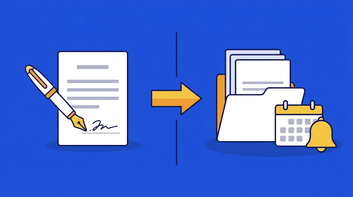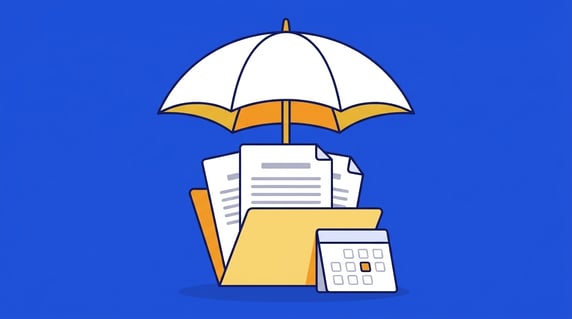
Quick answer: Contract management software for insurance companies is one searchable place for the contracts around your policies: reinsurance treaties, producer and MGA agreements, TPA and vendor contracts and HIPAA business associate agreements. Policies stay in your policy administration system. The software tracks renewal and notice dates and records who viewed or changed each contract, so the right person can find the right one when a deadline, a dispute or an examiner turns up.
Your claims TPA emails to say it's had a security incident. The CEO wants to know what the contract says about notice, and the only signed copy sits in a former employee's inbox.
Choose your next step:
If you're the one who gets that call, see how ContractSafe's contract tracking alerts each contract's owner before renewal and notice dates.
If you're sitting on scanned treaties and vendor paper, see how ContractSafe's AI pulls out renewal and termination dates, governing law and counterparties.
If you're sizing the budget, read our guide to choosing contract management software, then compare an enterprise CLM with ContractSafe, where every plan has unlimited users and no implementation fee.
Key Takeaways
- Your policy administration system holds the policies you issue. Contract management software handles the reinsurance, distribution, vendor and corporate contracts around them.
- Each contract type has its own terms to watch: treaty notice and commutation clauses, producer commissions and termination notice, and vendor SLAs, audit rights and breach-notice windows.
- State cybersecurity and data security rules expect insurers to oversee vendors that can reach nonpublic information, and examiners can ask for those contracts and who changed them.
- When a TPA or IT vendor has an incident, you should be able to list every contract with that vendor, and the notice each side owes, before the first call ends.
- Your CLM is a vendor too, so check its certifications, encryption and audit trail before you upload a treaty.
- Most regional carriers, agencies, MGAs and TPAs need search, owner alerts and department-level access more than an enterprise CLM rollout. ContractSafe includes unlimited users and charges no implementation fee.
What Is Contract Management Software for Insurance Companies?
Contract management software for insurance companies is the system that stores, searches and tracks the contracts around an insurer's policy business. Your policy administration system handles the policies you issue. The CLM keeps treaties, producer agreements and vendor contracts searchable, flags every renewal and notice deadline, and gives examiners and auditors a clean record of who did what.
Policies are contracts too, but you quote, bind, bill and service them in systems built for that job. The agreements that go missing are the ones nobody built a system for, like the treaty the CFO signed at renewal or the MGA agreement that quietly auto-renews.
Whichever tool you choose, it has three jobs to do:
- Find anything fast. Every contract, amendment and side letter sits in one searchable place, old scans included.
- Warn you before deadlines. Renewal, notice, commutation, termination and review dates trigger alerts that reach the right person early enough to act.
- Prove what happened. Permissions limit who sees what, and there's an activity trail you can show an auditor.
If your team already keeps contracts in a document management system, ask whether it does the second and third jobs. A folder can hold a treaty, but it can't warn anyone that the notice window is about to open or show who opened the file last week.
ContractSafe suits carriers, agencies, MGAs and TPAs that want those three jobs done without a long implementation project. One national high-net-worth personal lines carrier came to us with about 800 vendor and partner agreements and no central tracking system, and it now tracks every one in ContractSafe, with each department seeing only the contracts it works with.
The Insurance Contracts You'll Actually Manage
Outside the policy system, insurers manage six broad families of contracts: reinsurance, distribution, claims and service vendors, technology and data vendors, business associate agreements, and ordinary corporate contracts. Each family has its own dates and clauses, and missing them costs money.
| Contract type | Terms to track | Who usually needs access |
|---|---|---|
| Reinsurance treaties and facultative certificates | Effective and expiry dates, cession terms, commutation clauses, cancellation notice periods, the reinsurer's cyber-event notice contact | Reinsurance, finance, legal |
| MGA, producer and agency agreements | Commission schedules, binding authority limits, termination notice periods | Distribution, underwriting, legal |
| TPA and claims-vendor contracts | SLAs, audit rights, data handling, subcontractor terms | Claims, compliance |
| Technology, data and AI vendors | Security obligations, breach-notice windows, auto-renewals, price escalators, limits on training AI with your data | IT, security, procurement |
| Business associate agreements (health lines) | Permitted uses of PHI, safeguards, breach reporting, expiration | Compliance, privacy |
| Leases, employment, purchase and utility contracts | Renewal dates, notice periods, payment dates | Facilities, HR, finance |
Treaty notice and commutation windows usually run from an anniversary date, and anniversaries come around too rarely for anyone to remember them. If a notice window closes unnoticed, you've renewed on terms you meant to renegotiate. Put the reinsurer's cyber-event notice contact on the treaty record too, so a breach notice from the reinsurer reaches someone who knows what the treaty says.
Distribution contracts delegate real authority. An MGA agreement sets how much risk someone else can bind on your paper and how much notice either side needs to walk away. If those limits live only in one underwriter's memory, you'll learn what they say in the middle of a dispute.
Vendor contracts are where the volume is. The carrier in our case study describes itself as largely an IT business that runs on technology vendors, service providers and data partners, and each of those contracts has its own renewal date and price escalator. Add leases, employment agreements and purchase contracts, and that's more dates than one spreadsheet owner can watch.
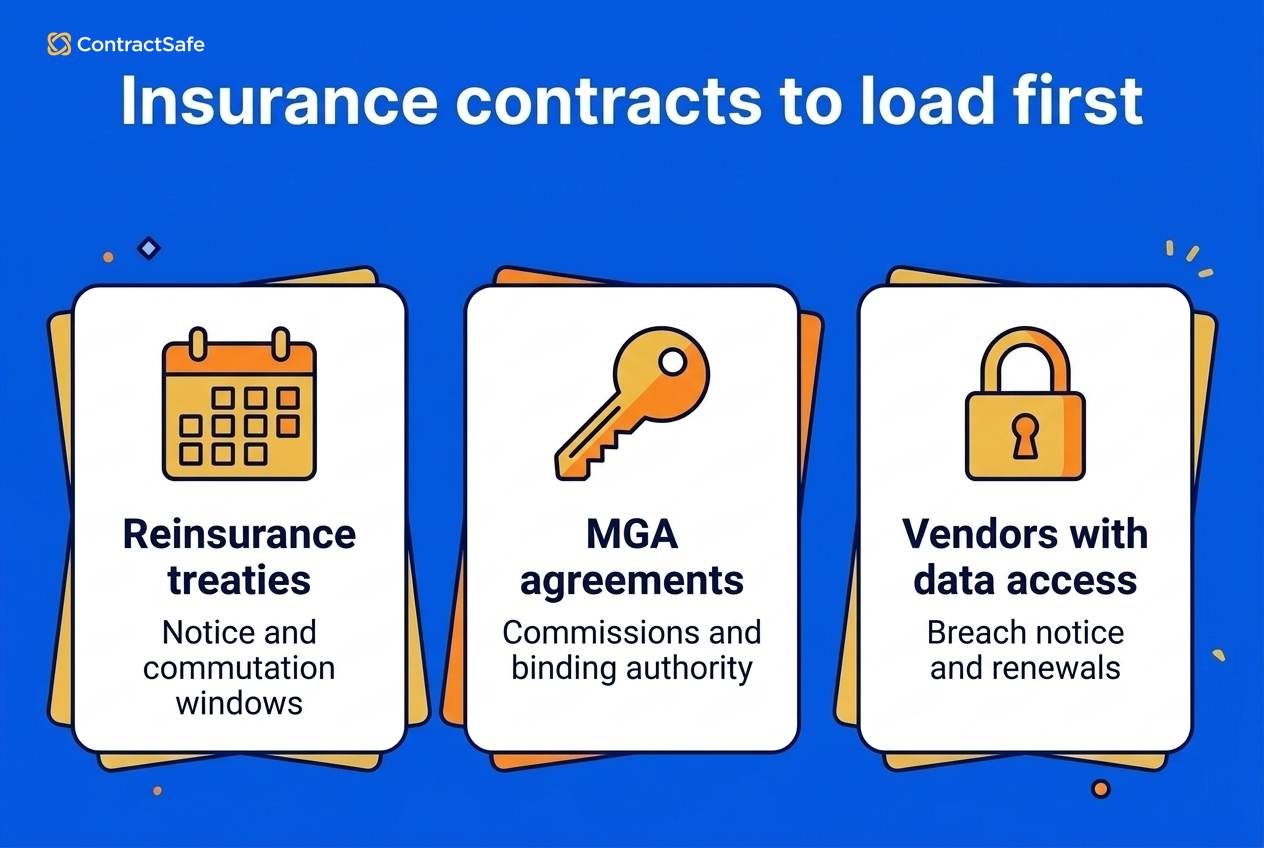
Load reinsurance treaties, MGA and producer agreements and any vendor that can reach nonpublic information or PHI first, since they do the most damage when a date slips. Leases and purchase contracts can follow once your alerts are set.
Why Shared Drives and Spreadsheets Stop Working
Shared drives and spreadsheets stop working once contracts outnumber the people who remember them. Here's how it usually shows up at an insurer:
- The signed treaty sits in one folder and the endorsement that changed it sits in someone's inbox.
- The renewal column in the tracking spreadsheet belongs to someone who has since left.
- Nobody owns the producer termination notice date, so nobody gets reminded before it passes.
The carrier in our case study hit that wall when its legal team wanted to get ahead of surprise price escalations and auto-renewals buried in contracts nobody was watching.
Deloitte's 2026 insurance outlook finds insurers wary of massive multi-year system replacements, and you don't need one to find a treaty. A searchable repository beside your core systems will do.
In ContractSafe, every contract gets an owner and a renewal alert, and the alert email arrives with the contract attached.
Where Contract Management Meets Insurance Regulation
Insurance regulators expect you to know what your vendor contracts say, to write specific protections into them and to produce them when an examiner asks. A repository with date alerts, permissions and an activity trail lets you do that calmly. This section maps rules to contract tasks and doesn't replace advice from your counsel.
New York. Insurers licensed in New York are covered entities under the Department of Financial Services cybersecurity regulation, 23 NYCRR Part 500, and section 500.11 calls for written policies on identifying, assessing, vetting and periodically reassessing third-party service providers. DFS's October 2025 guidance on third-party service providers lists baseline contract terms: multi-factor authentication, encryption, notice of cybersecurity events, data location, subcontractors, deleting or migrating your data at termination and whether your data may be used to train AI models.
The regulator is blunt about who carries the risk: "Covered Entities may not delegate responsibility for compliance with the Cybersecurity Regulation to an affiliate or a TPSP."
States using the NAIC data security model. The NAIC's April 2026 adoption map counts 28 jurisdictions that have adopted its Insurance Data Security Model Law, with New York running Part 500 instead. The model law, which got a technical edit in 2025, requires licensees to vet third-party service providers and to require them to protect the systems and nonpublic information they can reach.
Section 6E of the model law gives reinsurers a clock: an assuming insurer that determines a cybersecurity event has occurred must notify its affected ceding insurers and its home-state commissioner within 72 hours. That's why treaty contacts and notice clauses belong in your contract records.
AI and data vendors. On its AI bulletin adoption map, current through August 31, 2026, the NAIC shows 26 jurisdictions using its model bulletin on insurers' use of AI systems, while California, Colorado, New York and Texas have their own insurance-specific rules or guidance. Section 4.2 of the AI model bulletin, adopted in December 2023, points insurers toward third-party contract terms that "Provide audit rights and/or entitle the Insurer to receive audit reports by qualified auditing entities" and "Require the third party to cooperate with the Insurer with regard to regulatory inquiries and investigations".
The bulletin also lists contracts with third-party AI system, model and data vendors among the records examiners may request, so you'll want to pull them up by vendor type. If you buy pricing or underwriting data, tag those vendor contracts now, because the NAIC's third-party data working group is drafting rules for exactly those vendors.
Health lines. Business associate agreements already carry HIPAA obligations. In January 2025, HHS proposed an overhaul of the HIPAA Security Rule. It would require written verification from each business associate, at least once a year, that required technical safeguards are in place, and notice within 24 hours when a business associate activates a contingency plan. In a mid-2026 agenda update, HHS moved the rule to its long-term actions list, with final action targeted for July 2027, so annual verification isn't required today. A BAA review date still costs nothing to track, and it puts you ahead if the rule lands.
EU operations. If you also write business in the EU, DORA adds a register of your ICT contracts, which you can build from the same records.
Offboarding. Vendor oversight doesn't stop when a contract ends. The DFS guidance lists offboarding steps that include disabling the vendor's access and getting a certification of destruction of nonpublic information. Put the termination date on the contract record, set an alert a few weeks ahead and attach the deletion certificate when it arrives, so the next examiner who asks about a former vendor gets the paper instead of a shrug.
Here's what that looks like as a ContractSafe workflow:
- Tag every vendor contract that touches nonpublic information or PHI with custom fields and tags, such as data access and criticality, so you can filter the list in seconds.
- Add dates for reassessments, BAA reviews, regulator-driven vendor reviews and renewals, and set alerts early enough to finish diligence.
- Attach amendments, security questionnaires, insurance certificates and deletion certificates to the contract record, and connect related documents so they travel together.
- When an examiner asks, pull the contract, its amendments and the activity trail showing who viewed, downloaded or changed it.
Vendor Oversight When a TPA or IT Provider Has an Incident
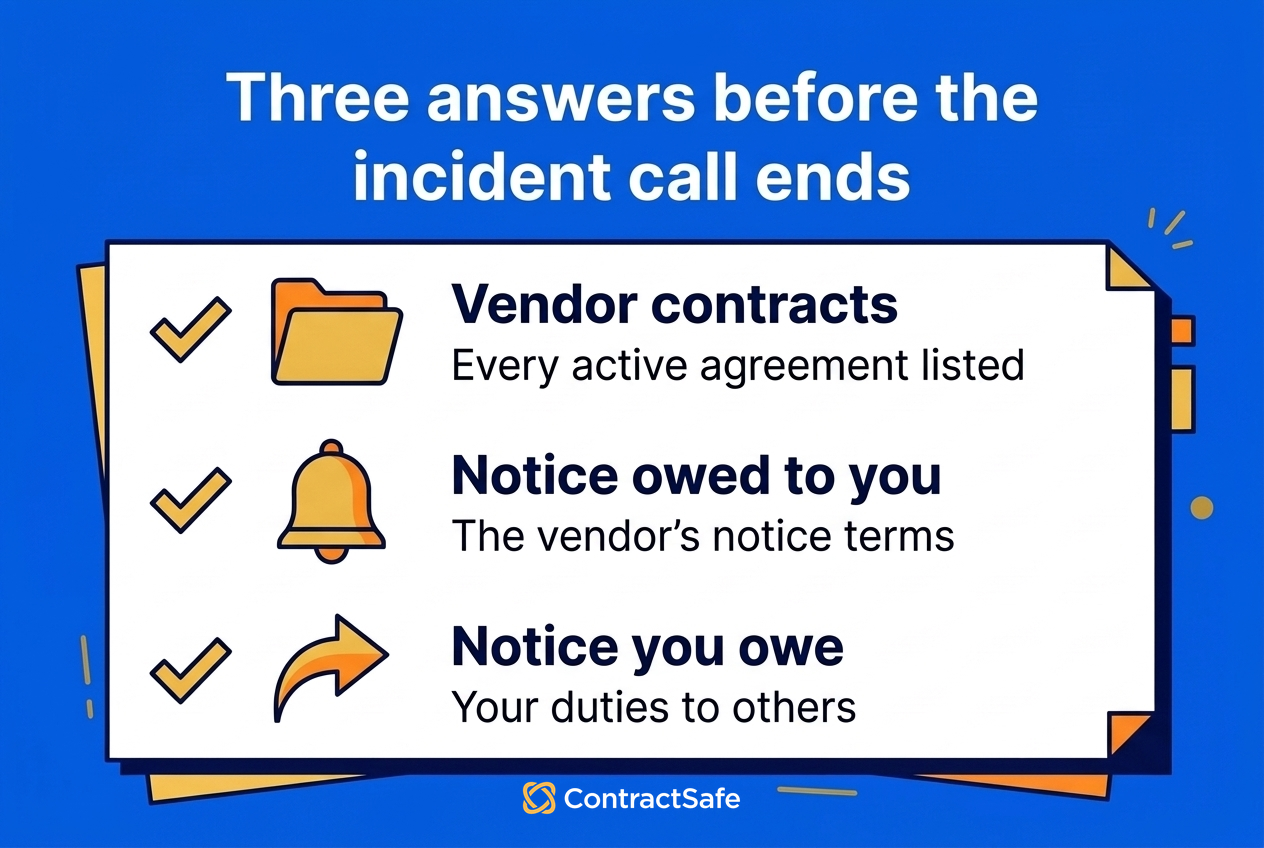
When a TPA, claims vendor or IT provider has an incident or misses its service levels, you need three answers fast: which contracts you have with that vendor, what notice it owes you and what notice you owe others. Your contract records should answer all three before the first incident call ends.
Say the file-transfer tool your claims team uses to share documents with partners gets breached. The vendor's name shows up in a master services agreement, a data-sharing addendum to a TPA contract and an order form someone in IT signed years ago. If those documents live in three different systems, the first day of your response goes on hunting for paper.
In ContractSafe, you search the vendor's name across every contract (scanned PDFs included), filter to the active ones and export a report. The same report earns its keep outside an incident, too. Candace Lovejoy, Director of Contracts and Project Management at SIGA, runs it every quarter: "The reporting tool is one of the features I use the most. I filter what I want, export to Excel, and send it. Contracts signed in the previous quarter, contracts expiring next quarter, anything. It’s a huge time saver."
For TPAs and claims vendors, record SLA terms, audit rights and contracted rates in custom fields, and set recurring reminders before each SLA review or audit window. When an invoice arrives, finance can check it against the contracted rate on the record without digging for the PDF.
Decision Check
Before your next vendor incident, run these five questions with whoever owns vendor risk.
- Could you list every contract with a single vendor before your incident call ends?
- Do you know which vendors can reach nonpublic information or PHI?
- Would anyone get an alert before the next treaty notice or producer termination window closes?
- Could you show an examiner who changed a vendor contract, and when?
- Could you prove a former vendor returned or destroyed your data?
If any of those gave you pause, your spreadsheet is carrying more than it was built for.
The ContractSafe Features Insurance Teams Use Most
Insurance teams lean on four ContractSafe features most: a searchable central repository, department-level permissions, date alerts and integrations with the tools they already use. Each one maps to a specific insurance job.
A repository you can search. ContractSafe keeps every treaty, producer agreement and vendor contract in one place, and OCR makes old scans keyword-searchable, so you can pull any contract with a reinsurer or vendor in seconds. Rebecca Dockum, Trade Contract Manager at Synergie, saw how that lands with colleagues: "People’s minds were blown the first time I showed them they could search every contract at once."
Permissions by department. Every plan includes unlimited users, and you can scope access by folder, tag, team or user, so claims, finance, compliance and distribution each see their own contracts. The carrier in our case study uses this so its marketing team sees only its own vendor agreements instead of the whole portfolio. Administrators can also set read-only or no-delete users, so nobody accidentally changes or removes a reinsurance treaty.
Alerts on the dates that matter. Treaty notice windows, producer termination notice, vendor auto-renewals and BAA reviews all go in as date fields, and ContractSafe sends alerts as far ahead as you choose, with the contract attached to the email. You can set recurring reminders, send alerts to any email address and see every upcoming date in one calendar.
Integrations. ContractSafe integrations with DocuSign, Word, Zapier and Okta/SAML 2.0 single sign-on come with the Finalize and Maximize plans, and Salesforce and API access come with Maximize.
What the AI Pulls Out of Insurance Contracts
ContractSafe's AI reads uploaded contracts, scans included, and suggests values for fields such as renewal dates, termination dates, governing law and counterparty names. You accept, correct or skip each suggestion before it's saved, so nobody keys in treaty and vendor deadlines by hand.
It also sorts contracts by type and lets you make fields mandatory for each type, so every BAA gets an expiration date and every producer agreement gets a termination notice period. Chat-based Q&A answers plain-English questions about a contract, such as "Can this vendor use our data to train its models?", which is exactly the term DFS wants you to address. Smart search finds contracts from a plain-language description and returns only contracts the user may see. ContractSafe doesn't use customer data to train AI models.
On the Maximize plan, AI Contract Review checks incoming contracts against your own playbook, flags risks and omissions such as a vendor agreement with no breach-notice clause, and suggests wording while a person decides whether to edit. Commission schedules, SLA levels and cession terms go in custom fields you define.
The AI features are optional. Treat each suggestion like a first-year associate's summary, and check it against the signed page before a date goes on the calendar.
Your CLM Is a Vendor Too
The software that holds your vendor contracts is itself a third-party service provider, so it needs the same diligence as any other vendor. Before you upload anything, ask about its certifications, encryption, hosting and audit trail.
ContractSafe runs on Amazon Web Services with offsite backup of all data. Our security features include SOC 2 audit certification, ISO 27001 certification, 256-bit AES encryption, dual-factor authentication, intrusion detection, penetration testing and HIPAA and GDPR compliance. Each account is assigned to one data-residency region: the US, the EU, Canada or Australia.
Ask, too, how you'd get your contracts back if you ever left. ContractSafe lets you download your own backup at any time, so your exit plan doesn't depend on anyone's goodwill.
Enterprise CLM or ContractSafe?
For most regional carriers, agencies, MGAs and TPAs, ContractSafe is the better fit. They mostly need every contract searchable, deadline alerts nobody misses and access for every department without per-seat fees.
An enterprise CLM earns its keep when your underwriters draft manuscript wordings and route broker slips through the contract tool itself, which is the work enterprise platforms such as Sirion, with its broker-slip and submission-triage workflows for insurers, are made for. If you're weighing another enterprise platform, our ContractSafe vs. Icertis comparison lays out the trade-offs.
ContractSafe pricing starts at $450/month (Organize plan, billed annually; $540 month-to-month), with unlimited users on every plan. There's no implementation fee, and every plan includes onboarding, training, data and document migration and a dedicated customer success manager. Bulk and email uploads bring your existing contracts in. That matters in insurance, where claims, finance, compliance and distribution all need to reach contracts, and a seat count quickly turns into a budget fight.
| Question | Enterprise CLM | ContractSafe |
|---|---|---|
| Best fit | Global carriers with complex authoring and broker-slip workflows | Regional and national carriers, agencies, MGAs, TPAs |
| Users | Ask how users and modules are licensed | Unlimited users on every plan |
| Implementation | Ask for the timeline and services cost in writing | No implementation fee; onboarding and migration support included |
| Pricing | Ask whether it's published or quoted | Published for every plan |
| AI | Ask what it extracts without professional services | Field extraction and chat Q&A on every plan; AI Contract Review on Maximize |
A sensible rollout for a regional carrier or MGA starts small. Bulk upload your treaties, producer agreements and data vendors, let the AI suggest dates and counterparties, and have each department owner confirm the fields on their own contracts. Once those alerts are running, bring in leases, employment agreements and purchase contracts. If a vendor can't describe your first month without a statement of work, you've learned something about the years that follow.
Before you sign with anyone, ask three questions:
- How soon will we be live, and who does the migration?
- What will it cost as we add users from claims, finance and compliance?
- Will it surface treaty and producer notice deadlines without someone keying them in?
Related Reading
How ContractSafe Helps Insurance Companies Keep Every Contract Under Control
ContractSafe gives insurers one searchable home for treaties, producer agreements, vendor contracts and BAAs, with date alerts, AI that reads your contracts and department-level permissions with an activity trail you can show an examiner.
You won't pay an implementation fee for our contract management software, and onboarding, training and data migration come with every plan. For a first test, upload your treaties and every vendor holding nonpublic information, then check that each notice window has an owner and an alert.